

Note: This article was originally published on November 15, 2022 and updated on June 18, 2026
What's New with FSMA 204?
|
As the food industry moves further into the implementation phase of the Final Traceability Rule outlined in section 204 of the FDA Food Safety Modernization Act (FSMA), the collective focus has begun to shift from understanding — getting its arms around the substance of the new compliance guidelines — to action — mapping out how they'll actually get there.
Ongoing: 2026 FDA Public Meetings & PFT Stakeholder Roundtables
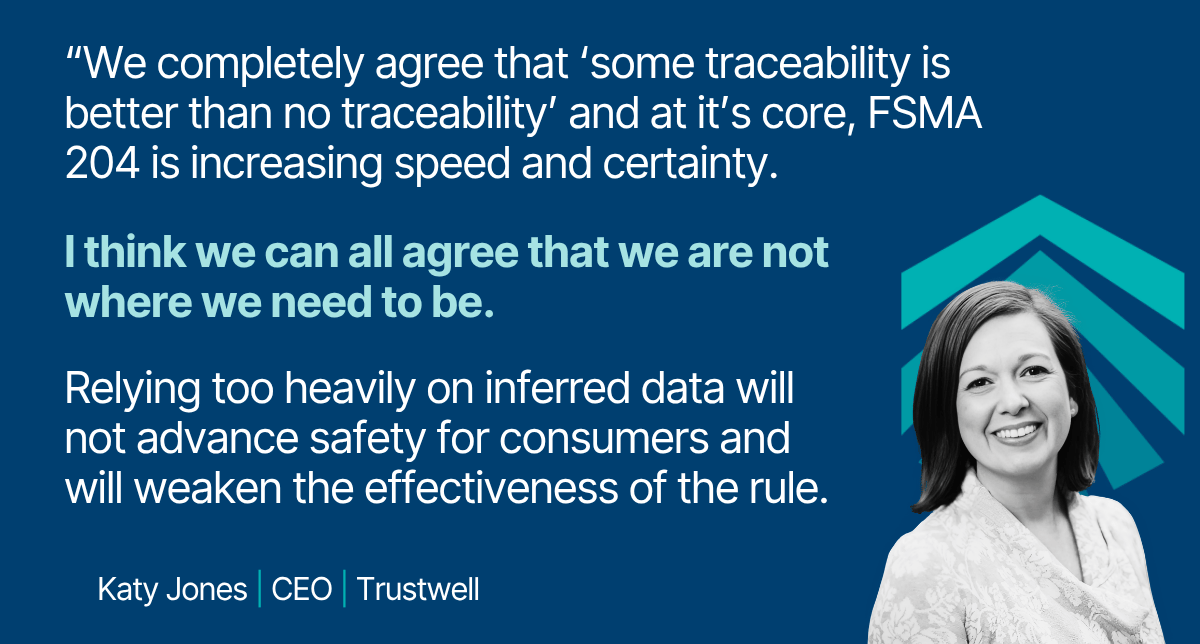
To address the practical hurdles of lot-level tracking before the July 20, 2028 deadline, the FDA has established a series of public meetings and collaborative industry listening sessions throughout the remainder of 2026. Trustwell is actively participating in these high-stakes discussions to ensure our community's operational challenges are heard at the agency level.
- June 15, 2026 | FDA Public Meeting: "Challenges and Solutions for Lot-Level Food Traceability"
The FDA's recent major public forum focused directly on resolving lot-level tracking complexities. During the public comment portion of this town hall, two Trustwell team members spoke directly to the agency. Katy Jones, CEO of Trustwell, addressed inferred traceability data and data standards, emphasizing the importance of practical flexibility while keeping whole-chain lot-level traceability as the goal. Julie McGill, Trustwell’s VP of Supply Chain Strategy and Insights, spoke on behalf of AIM North America and highlighted the role of technology neutrality, global standards, and AIDC technologies in supporting accurate, scalable traceability across complex supply chains.
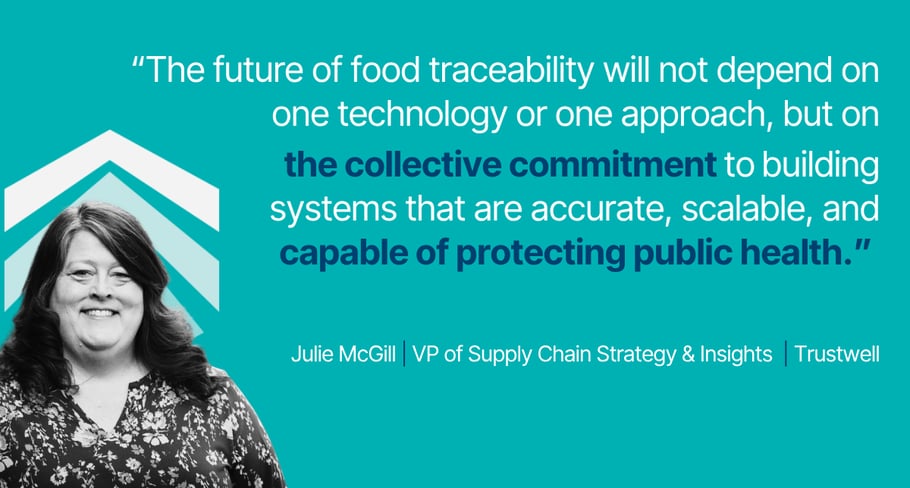
Read More: Trustwell Leaders Speak at FDA Public Meeting on Lot-Level Traceability and FSMA 204
- September 25, 2026 | PFT Stakeholder Roundtable
The Partnership for Food Traceability (PFT) will host another dedicated public-private listening session to facilitate an open, non-adversarial exchange of information between regulators and the food sector. These roundtables bring together trade associations, technical experts, and businesses of all sizes to dissect implementation roadblocks and pitch unified solutions. - November 6, 2026 | FDA Public Meeting
The FDA will anchor the year's formal tracking evaluation with a final public assembly designed to review progress and weigh potential rule flexibilities before heading into the new year. Additional information about this meeting is forthcoming, so watch this space.
NEW: FDA Discussion Paper Explores Lot-Level Flexibilities
The FDA released a discussion paper ahead of the June 15 town hall to address and explore administrative flexibilities for lot-level recordkeeping. The paper outlines potential relief for complex compliance scenarios, including handling mixed-pallet tracking via reasonable or inferred TLC ranges, managing loose items ("eaches") from broken cases, and simplifying data requirements for returns and food waste recovery.
The agency is also actively evaluating ways to mitigate duplicate records during intracompany shipments, adjust transformation rules for central retail kitchens, and align the sector around universal data standards.
Read the discussion paper in its entirety here: Identifying Additional Flexibilities for Satisfying the Food Traceability Rule’s Lot-Level Tracking Requirement
The FDA is encouraging industry stakeholders to continue to leave feedback, on the contents of the paper. The public comment period is open until July 15, 2026 and interested stakeholders can submit to Docket No. FDA-2014-N-0053 to discuss challenges, opportunities, and questions they may have until then,
NEW: 2026 Tabletop Exercises Highlight Implementation Gaps
The FDA recently released the FDA Traceability Readiness Tabletop Exercises Final Report detailing compliance simulations conducted with 15 voluntary companies between March 9 and April 1, 2026. While most participating firms successfully met the mandatory 24-hour window to provide an electronic sortable spreadsheet, the exercises exposed critical operational vulnerabilities that the industry must address before 2028. Key findings include:
- Supply Chain Alignment is Critical: Communication and predefined data expectations among trading partners proved far more essential to traceback success than any individual software solution or data carrier.
- The TLC Data Gap: Traceability Lot Codes (TLCs) appeared in 80% of participant records, but only 40% of firms successfully maintained a consistent lot code across every Critical Tracking Event (CTE) they performed.
- Separation of Required Elements: Firms frequently struggled to link TLCs with their corresponding physical TLC sources, proving that the omission of these related data points represents distinct operational gaps.
- Inconsistent Buyer Rules: Distributors and suppliers reported that fragmented, non-standard compliance formatting demands required by individual corporate buyers add severe administrative friction.
Read the report in its entirety here: FDA Traceability Readiness Tabletop Exercises Final Report
|
Trustwell is committed to helping you navigate the complexities of food safety regulations as they evolve. We actively monitor FDA announcements, Congressional directives, and industry shifts to ensure our guidance reflects the most current requirements. As the FSMA 204 Food Traceability Rule continues to change, we will update our resources and share the critical insights your business needs to remain compliant. |
FSMA 204: The Food Traceability Rule
FSMA 204 establishes traceability recordkeeping requirements for designated foods on the FDA’s Food Traceability List (FTL). This groundbreaking and ambitious final rule is built upon the foundation of the Food Safety Modernization Act (FSMA), with Section 204 requiring the FDA to designate foods for which additional recordkeeping requirements are appropriate and necessary to protect public health. The focus of FSMA is to transform our nation’s food safety system by shifting the focus from reacting to foodborne illness to preventing it.
While the core requirements of FSMA 204 have remained consistent since 2022, the path to compliance has been reshaped thanks to widespread awareness and education efforts. The most significant change is the extension of the compliance deadline to July 20, 2028. This extra time revises the roadmap to achieving compliance, allowing for a more strategic and informed path to enhanced traceability.
Our Take: FDA Announces FSMA 204 Compliance Delay, But Food Safety Can't Wait
An important outcome of the Food Safety Modernization Act (FSMA), and specifically Section 204's Food Traceability Rule, is that companies handling foods on the FTL must move from basic “one-up/one-back” traceability to much more granular, event-based traceability and recordkeeping. This has significantly changed how many companies manage operations, data, and supplier relationships. Now, with the new July 20, 2028 compliance deadline approaches, industry leaders have moved beyond basic prevention into the era of full digital supply chain traceability.
And if they haven't, now is the time to start.
The Updated FSMA 204 Compliance Deadline: July 20, 2028
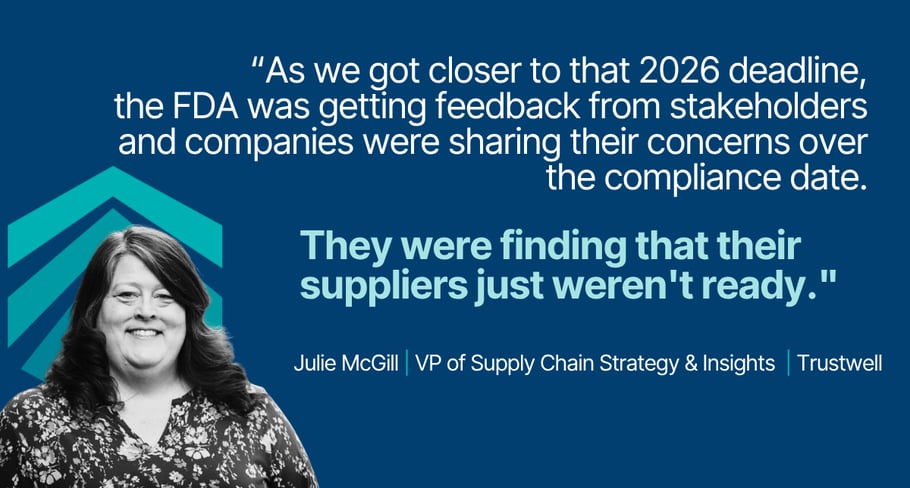
Originally slated for early 2026, the FDA first proposed a 30-month extension for FSMA 204 enforcement in March 2025, and a subsequent congressional directive in November 2025 made it official.
This additional time is intended to allow industry operators at every level to be thorough and rigorous as they develop comprehensive traceability programs that can collect and provide the required data. It's a very big, very important job, and the updated FSMA 204 compliance deadline acknowledges and allows for that.
Read More: The Smart Leader's Guide to the New FSMA 204 Compliance Date
While 2028 may seem distant, the complexity of capturing Critical Tracking Events (CTEs) and Key Data Elements (KDEs) across multiple supply chain partners requires aggressive action today.
Start Here: Download This Free, Comprehensive Guide to FSMA 204 Compliance (Updated for 2026)
What is the Food Traceability List (FTL)?
At the core of FSMA 204 compliance is the Food Traceability List (FTL). This list is a major factor in determining whether your business must comply with the enhanced recordkeeping requirements of the final traceability rule. Specifically, If you manufacture, process, pack, or hold any food item found on the FTL, or use an FTL item as an ingredient in a way that maintains its fresh state, you are legally required to comply by the July 2028 deadline.
The FTL is a risk-based catalog of foods that the FDA has identified as having a higher potential for foodborne illness outbreaks. It includes a wide range of categories and specific items, such as:
 |
 |
 |
 |
 |
 |
| Crustaceans | Bivalve Molluscan Shellfish | Finfish | Cheese | Eggs | Nut butters |
 |
 |
 |
 |
 |
|
| Leafy Greens | Ready-to-Eat Salads | Fresh Cut Vegetables | Herbs | Sprouts | |
 |
 |
 |
 |
 |
 |
| Peppers | Tomatoes | Cucumbers | Tropical Fruit | Fresh Cut Fruit | Melons |
Keep in mind that these examples are not representative of the comprehensive FTL, which the FDA formally reviews and updates every five years to ensure the regulations reflect the most current food safety data. Because items can be added or clarified during these cycles, it is critical for businesses to stay informed of the latest designations and exemptions.
For a complete and definitive list of commodities on the FTL, from specific soft cheeses to various fresh-cut fruits and seafood, it's always best to review the FDA’s full Food Traceability List. Trustwell strives to stay abreast of FTL changes and updates, and you can now download our simplified, quick-reference Food Traceability List Cheat Sheet, recently updated for 2026.
Get Your Copy: FSMA 204 Food Traceability List Cheat Sheet
Recent Updates and Clarifications to the FTL
As of 2026, several key clarifications have been made regarding the scope of the FTL:
-
Form Matters: The rule primarily targets "fresh" forms of commodities. For example, fresh spinach is on the FTL, but frozen spinach is not. Similarly, fresh peppers are covered, while dried peppers are exempt.
-
Ingredient Inclusion: If an FTL food is used as an ingredient (e.g., fresh tomato slices in a pre-packaged sandwich), the final multi-ingredient product remains subject to the rule because the FTL item is still in its fresh form.
-
The "Kill Step" Ending: If an FTL food undergoes a validated "kill step" (like high-heat pasteurization or pressure processing), the enhanced traceability requirements typically end at that point in the chain.
Determining your FTL status is a critical first step in your roadmap. Because the FDA is required to review and update this list every five years, businesses must implement flexible traceability systems that can adapt as new food categories are added or removed.
Enhanced Traceability Recordkeeping: CTEs and KDEs
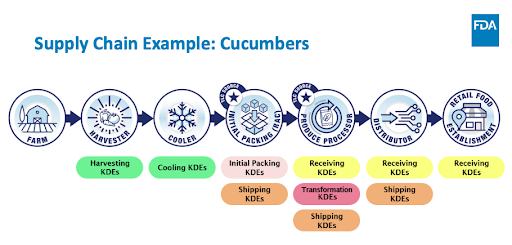
There were several differences between the proposed and the final rule for FSMA 204. These updates centered on a more granular definition of the supply chain checkpoints where data capture is now mandatory to ensure full, lot-level visibility. Here are the mandatory Critical Tracking events (CTEs) that require specific recordkeeping:
-
Harvesting: Applies to farms and farm mixed-type facilities and means activities that are traditionally performed on farms for the purpose of removing raw agricultural commodities (RACs) from the place they are grown or raised and preparing them for use as food.
-
Cooling: Active temperature reduction of a raw agricultural commodity (RAC) using hydrocooling, icing (except icing of seafood), forced air cooling, vacuum cooling, or a similar process.
-
Initial Packing: Packing a raw agricultural commodity (RAC), other than a food obtained from a fishing vessel, for the first time.
-
First Land-Based Receiver: The person taking possession of a food for the first time on land directly from a fishing vessel.
-
Shipping: An event in a food's supply chain in which a food is arranged for transport from one location to another. This includes intracompany shipments between different physical addresses.
-
Receiving: An event in a food's supply chain in which a food is received by someone other than a consumer.
-
Transformation: An event involving manufacturing, processing, or changing a food (e.g., by commingling, repacking, or relabeling) where the output is a food on the Food Traceability List (FTL).
Your Traceability Plan: The Digital Requirement
If you are subject to the requirements of the final rule, you must establish and maintain a traceability plan. In 2026, the standard for these plans has evolved from simple documentation to digital frameworks that support interoperability. Your plan must contain:
-
Procedures for record maintenance: A description of the procedures used to maintain records, including the specific format and storage location
-
Identification of FTL foods: A description of the procedures used to identify foods on the Food Traceability List (FTL) within your operations
-
Traceability lot codes: An explanation of how you assign traceability lot codes to FTL foods
-
Point of contact: A designated individual who can answer questions regarding your traceability plan and records and how to reach them
-
Farm map (if applicable): A map showing growing areas with geographic coordinates for any applicable farms
|
|
Data Collection: The 24-Hour Rule
The FDA has made it clear that "recordkeeping" no longer means "filing cabinets." During an outbreak or investigation, the agencies expectations for data retrieval are strict:
-
24-Hour Response: You must provide requested records to the FDA within 24 hours of a request
-
Electronic Sortable Spreadsheet (ESS): When requested during an outbreak or recall, records must be provided in an electronic sortable spreadsheet. Many legacy paper-based systems are finding it impossible to meet this requirement, making digital transformation a necessity rather than an option
-
Retention: Records must be maintained for 24 months (2 years)
Free Download: The Ultimate Data Integrity Checklist for Food Safety & Quality Teams
Your Roadmap to 2028 Traceability: Achieving FSMA 204 Compliance with Trustwell
In order for food companies to be successful in their FSMA 204 journey, we recognize that:
- Tech-Enabled traceability and digital interoperability is essential for competitive food businesses and provides business value beyond compliance and consumer protection
- Companies are at risk if they do not understand their role and approach to capturing and sharing enhanced traceability data. Companies also need to realize that our food supply chain is an ecosystem, and leading brands are utilizing industry standards to enable data capture and sharing across their supply chains.
- The extended timeline is not a reason to delay; it's a strategic head start that teams can use to test their supply chain traceability programs before the July 2028 deadline turns "best effort" into a high-stakes legal requirement.
Trustwell has been an active member of this journey since the beginning. Our teams helped shape policy at the national level, including participating in the FDA’s traceability pilots that were implemented as part of FSMA Section 204. We have worked hand-in-hand with the food industry’s leading innovators to develop our industry-leading traceability and food transparency solutions.
Case Study: Taco John’s Embraces Tech-Enabled Traceability with Trustwell’s FoodLogiQ
We support some of the largest foodservice operators, food manufacturers and grocers in the world. This provides us with a unique perspective regarding today’s challenges and future opportunities facing food industry partners when implementing traceability programs.
On-Demand Webinar: A Fresh Take on Traceability with Del Monte: How FSMA 204 is Reshaping Complex, Global Supply Chains
.jpg?width=498&height=374&name=Trustwell-Foodlogiq-digital-traceability-1600x1200_0006_1A4A7423%20(2).jpg) Safe, digital, traceable food systems are achievable. All it takes is a new approach that leverages a combination of tools, technology and expertise that can evolve alongside consumer demands and industry regulations.
Safe, digital, traceable food systems are achievable. All it takes is a new approach that leverages a combination of tools, technology and expertise that can evolve alongside consumer demands and industry regulations.
Trustwell leads the industry in tech-enabled food traceability with FoodLogiQ's family of solutions, which together form a unified supply chain management platform built on a foundation of GS1 Standards, utilizing Key Data Elements (KDEs) and Critical Tracking Events (CTEs) to support lot-level traceability.
Archived 2026 Timeline: Earlier Milestones & Guidance Updates
Spring 2026: FDA Quarterly Stakeholder Engagement Sessions
The FDA also announced a series of quarterly stakeholder engagement sessions designed to address the practical challenges of implementing the Food Traceability Final Rule before the July 20, 2028 deadline. The inaugural session was held on March 6, 2026 with the Partnership for Food Traceability (PFT), an industry-driven, independent, sector-neutral nonprofit partnership with the FDA and state governments. General public sessions are scheduled to begin in the second quarter of 2026. The FDA has since expanded this schedule to include a public meeting titled "Challenges and Solutions for Lot-Level Traceability" on June 15, 2026, an additional focused industry session in September 2026, and a subsequent public meeting scheduled for November 6, 2026.
Winter 2026: FSMA 204 Industry Q&A Draft Guidance
New draft guidance issued by the FDA on February 19, 2026 answers several scenario-based questions for the edification of industry stakeholders. Significant takeaways include the application of exemptions for small produce farms with annual sales under $25,000, partial exemptions for ad hoc purchases at the retail level, and specific recordkeeping relief for products subjected to a "kill step" or commingled raw agricultural commodities.
The document also defines logistical roles, identifying the initial packer as the first to pack a raw agricultural commodity for commerce, and explains that "transformation" events like repacking or relabeling require new records to ensure continuity in the supply chain.
Listen In: FSMA 204 Is Coming: Is Your Supply Chain Ready?
Ultimately, firms remain responsible for providing requested records to the FDA within 24 hours, even if a third party manages the data on their behalf, and the FDA emphasizes that the digitization of traceability records will help ensure that they can fulfill such a request.
Winter 2026: The Grade “A” Cottage Cheese Exemption (Effective February 20, 2026)
While cottage cheese originally fell under the "Fresh Soft or Soft Unripened Cheese" category on the Food Traceability List (FTL), the FDA has granted a specific exemption for IMS-listed Grade “A” cottage cheese.
- Who is exempt? Facilities that manufacture, process, pack, or hold cottage cheese that is regulated under the Grade “A” Pasteurized Milk Ordinance (PMO) and appears on the Interstate Milk Shippers (IMS) List.
- Why did this change? The FDA concluded that the existing PMO regulations already provide rigorous, science-based oversight and processing requirements. Because these standards already address the risk factors that landed cottage cheese on the FTL, additional FSMA 204 record-keeping was deemed unnecessary for public health protection.
- What is still required? You aren't completely off the hook. Even exempt facilities must still maintain "one-up/one-back" records. This means you must still identify the immediate previous source and the immediate subsequent recipient of the product, but you do not need to maintain the complex CTE/KDE digital data or provide the 24-hour electronic spreadsheet for this specific product
Ready to Get Started?
As part of our commitment to your success, Trustwell provides the technical expertise and regulatory intelligence needed to navigate the July 20, 2028, compliance deadline.
Whether you are identifying which of your products appear on the Food Traceability List or mapping your Critical Tracking Events, our team is here to support your digital transformation.
Get in touch today to leverage our expertise in food supply chain strategy and FSMA 204 compliance and ensure your brand is strategically prepared for the next era of food safety.
Other posts you might be interested in
View All Posts
Food Industry
8 min read
| March 28, 2023
What do Restaurants, Retailers, & Distributors Need to Know About FSMA 204?
Read More.png?length=360&name=September_Demo_Banner%20(1).png)
Trustwell News
5 min read
| September 6, 2022
LIVE DEMO | Roadmap to FSMA 204: 5 Critical Steps
Read More
6 min read
| March 24, 2023