

As the food industry prepares for FSMA 204, I’m hearing a common question from leaders across the supply chain: “If we invest in the right technology, are we ready?”
Technology is essential, but it is not the full answer. Food traceability software can process complex data, connect trading partners, and provide a strong framework for managing Critical Tracking Events (CTEs) and Key Data Elements (KDEs). But purchasing a new platform does not create a working traceability program on its own.
FSMA 204 readiness is also a leadership issue. It should not sit solely with IT or FSQA. Success requires cross-functional alignment across operations, procurement, quality, supply chain, and executive leadership. Each team must understand its role, share accountability, and support consistent execution across the business.
Readiness comes from pairing connected systems with clear ownership, disciplined processes, and committed teams. Employees must capture accurate data, resolve daily exceptions, and work closely with suppliers and trading partners. Comprehensive food traceability software provides the visibility and structure, while people, processes, and leadership turn that foundation into a program that works every day.
The Trap of the 'Tech-Only' Traceability Solution
Many organizations purchase a modern supply chain platform and assume their FSMA 204 compliance goals are most of the way to being met. This mindset creates significant operational risks. It's absolutely true that the enhanced recordkeeping requirements of FSMA 204 will require the widespread adoption of technology to centralize and digitize traceability data. Food companies must actively build the procedures, define the rules, and execute the daily tasks to make that framework functional. A platform provides a digital repository. Human accountability ensures food safety and meets stringent regulatory requirements.

5 Food Traceability Problems Software Cannot Solve on Its Own
1. Unclear process ownership
Gaps appear rapidly when organizations fail to assign explicit responsibility for daily traceability tasks. Someone must physically collect, review, correct, and share KDEs. The daily reality of food safety and supply chain management involves multiple departments executing specific CTEs:
- Receiving: Logs incoming shipments and verifies bills of lading
- Production: Records ingredient usage and lot codes during manufacturing
- Shipping: Documents the final destination of finished goods
- FSQA: Signs off on compliance checks and reviews discrepancies
- Procurement: Communicates missing data requirements to vendors
- IT: Maintains internal data pipelines and system integrations
A good software platform will flag missing information and display blank fields on a dashboard, but a specific person must hold the authority to resolve those alerts. Teams need documented ownership to turn system alerts into actionable corrections. Creating a Traceability Lot Code (TLC) requires absolute precision during the initial packing phase. Failing to assign clear authority for this single aruarancan create downstream gaps.
2. Incomplete or inconsistent source data
Bad data cripples the most advanced technology platforms and disrupts end-to-end supply chain visibility. Data hygiene problems frequently disrupt operations:
- Mismatched identifiers: Product codes differ across internal systems
- Inconsistent naming: Facilities use varying location names or facility codes
- Missing information: Vendors forget critical lot codes on shipping documents
- Data entry errors: Users enter incorrect expiration or harvest dates
- Siloed storage: Teams bury essential records in spreadsheets, emails, or filing cabinets
Read More: A Food Safety Data Strategy for FSQA Teams
Migrating weak data into a modern platform produces unreliable reports. Technology simply amplifies the existing errors. Data governance solves this issue directly. Organizations must define clear data standards for all internal and external participants. Managers must assign record owners for every Critical Tracking Event. Teams must establish strict validation and correction procedures to catch errors before they enter the main database. Validating location descriptions ensures regulatory inspectors can pinpoint exact facilities during an outbreak. Standardizing unit of measure terminology prevents costly or avoidable errors during product withdrawals.
3. Suppliers and Trading Partners That Are Unprepared for FSMA 204 Recordkeeping
Traceability readiness demands accurate information from the entire network, regardless of their technical maturity. Organizations depend entirely on the capabilities of their growers, processors, co-manufacturers, distributors, logistics providers, and final customers.
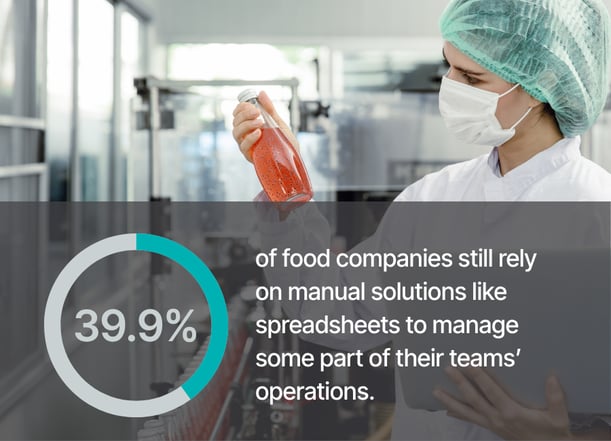
These partners operate with wildly different technical budgets and capabilities. Some are high tech already; executing automated data exchanges through modern application programming interfaces (APIs).
But some trading partners are much more low tech, requiring manual portal entry, spreadsheet templates, training sessions, or phone support. And there are more of them than you may think. Nearly 40% of the food companies we surveyed said they were still relying on manual tools like spreadsheets somewhere in their team's operations.
Survey Report: The 2026 State of the Food Tech Stack
Supplier onboarding must begin long before your team finalizes any internal software integration decisions. Early conversations uncover data gaps that you cannot bake into your traceability program if you expect it to comply with FSMA 204. Discussions will also reveal terminology conflicts and process limitations, so proactive communication builds a resilient supply chain network and ensures high adoption rates ahead of the July 2028 compliance deadline.
Read More: The Smart Leader's Guide to the New FSMA 204 Compliance Date
4. Teams That Lack Training for Daily Execution
Users require a deep understanding of both the software interface and the operational logic behind FSMA 204 data requirements. Role-based training empowers employees to execute their specific responsibilities accurately:
- Data Hygiene: Frontline employees need precise data capture skills
- Management: Approvers require analytical skills to spot anomalies
- FSQA: Investigators need specific workflows to isolate exceptions
- Procurement: Supplier managers need distinct communication protocols
- Crisis Response: Recall teams must act rapidly with total system fluency
5. Untested Traceability Procedures
A clean daily dashboard guarantees nothing during an actual FDA investigation. Companies must prove their capability to respond under intense regulatory pressure and meet the twenty-four-hour data retrieval mandate. Mock recalls and formal record-retrieval exercises reveal the truth about organizational readiness. These drills test the software systems and the people operating them, evaluating critical functions like partner communication channels, internal escalation paths, and executive decision-making speed.
Customer Story: First Watch Advances Food Safety, Reduces Response Time for Recalls
Teams must measure their actual retrieval time against internal targets and regulatory requirements. Auditors must verify data completeness and affected-lot accuracy down to the specific ingredient. Managers must track partner response rates and evaluate the effectiveness of the resulting corrective actions.
Where Food Traceability Software Provides the Most Value
Food traceability platforms serve a specific and powerful purpose within a comprehensive traceability compliance program, and the recordkeeping requirements in FSMA 204 absolutely makes investing in the right one a very smart move. With the right operational foundation undergirding it, traceability software becomes the engine that scales your success. The technology takes your precise physical handling and translates it into digital visibility across a network of trading partners.
Enabling System Interoperability
Food traceability software should speak the language of your supply chain. Because different trading partners frequently rely on varying internal technology systems, a connected platform bridges these technical gaps to share critical tracking information automatically. This level of interoperability removes the heavy burden of manual data entry and endless email attachments. Establishing this fluid connection is made possible by relying on universally recognized data standards like GS1, which provide a common digital vocabulary.
Streamlining Supplier Collaboration
Operating on a shared digital ledger dramatically improves supplier collaboration across your network. By verifying product identifiers and tracking events the moment a shipment arrives at your receiving dock, the system empowers your FSQA team to coordinate with the supplier and resolve any missing Traceability Lot Codes immediately. This proactive communication streamlines your compliance processes while guaranteeing your traceability readiness well ahead of looming regulatory deadlines.
Enhancing Recall Preparedness
A dedicated supply chain platform can support a faster, more coordinated response during critical safety events. Automating the capture of key data elements from farm to shelf drastically increases your visibility across the board, which significantly enhances your overall recall preparedness. With accurate and connected records, your FSQA professionals can identify specific affected batches in minutes to protect public health efficiently. Building a practical and scalable program with this software ultimately makes your business a more trusted and prepared partner for major retailers.
Resilient Food Traceability for FSMA 204 & Beyond
Meaningful supply chain visibility demands dedicated teams and clear operational procedures, and powerful software amplifies the disciplined work of food safety professionals. Navigating the complexities of FSMA 204 and lot-level traceability requires more than will; it demands a robust, connected technology partner. Trustwell’s FoodLogiQ is explicitly designed to help industry leaders meet these rigorous regulatory mandates and help food companies turn basic compliance into operational excellence.
As traceability expectations continue to change, building a practical and scalable program is the most critical step you can take to safeguard the future of your supply chain. To explore exactly how to bridge the gap between your daily operational habits and advanced software execution, download our comprehensive whitepaper, Building Traceability Programs That Work. Inside, you will find the actionable insights needed to protect your brand, streamline your compliance strategies, and ensure your facility is fully prepared for whatever comes next.
FSMA 204 readiness is not achieved through a single system purchase. It is built through consistent execution, clear accountability, and the right technology foundation. Organizations that start that work now will be better prepared not only for compliance, but for a more transparent, resilient, and trusted food supply chain.
Other posts you might be interested in
View All Posts
Traceability
10 min read
| July 8, 2026
The 5 Building Blocks of a Scalable Traceability Program
Read More
Food Industry
5 min read
| April 18, 2023
Trustwell Launches New Podcast: Transparency Talk with Trustwell
Read More
Food Industry
12 min read
| January 28, 2025