

Restaurant brands have made it easier than ever for customers to build a meal exactly how they want it. But behind every protein swap, extra topping, and ingredient substitution is a nutrition calculation that needs to keep pace. When the values displayed on a website, mobile app, or ordering kiosk reflect the standard recipe instead of the customized order, even the most sophisticated digital ordering experience can deliver misleading nutrition information.
For multi-location restaurant brands, maintaining menu nutrition accuracy becomes increasingly complex as menus expand, recipes evolve, and customers personalize orders across multiple channels. Nutrition, menu operations, and technology teams must coordinate ingredient data, portion sizes, modifier calculations, and system updates to provide consistent information at scale.
Understanding where nutrition accuracy breaks down is an important step toward improving it. These five common failure points reveal where restaurant brands should focus their attention as they build more reliable, responsive nutrition experiences.
1. Nutrition Calculations Stop at the Standard Menu Item
Traditional restaurant nutrition analysis starts with a defined recipe. Ingredients, quantities, and preparation methods are used to calculate the nutritional profile of a standard menu item, which then becomes the basis for published calorie counts and other nutrient information.
Start Here: Download the Menu Labeling 101 eBook
As customers personalize their orders, restaurants need to account for nutritional changes that extend beyond the original recipe.
Consider a burrito bowl containing rice, beans, chicken, cheese, and salsa. When a customer substitutes steak, removes rice, and adds guacamole, the nutritional profile changes. Restaurants relying on calculations for the standard recipe cannot accurately represent every customized combination.
Each adjustment affects the nutritional composition of the meal, including calories, protein, sodium, saturated fat, and other nutrients. Customers who monitor sodium intake or look for higher-protein options depend on relevant nutrient values to make informed selections.
According to the FDA's menu labeling guidance, Americans consume approximately one-third of their calories away from home, reinforcing the importance of accessible restaurant nutrition information.
For restaurants offering extensive customization, maintaining menu nutrition accuracy requires calculations that account for the ingredients and portions customers actually select.
2. Modifier Nutrition Data Is Disconnected from the Base Recipe
Proteins, sauces, dressings, toppings, sides, and portion adjustments each contribute to a meal's nutritional composition. Restaurants need accurate nutrition information for these components, along with a way to calculate how they affect the finished meal.
When ingredient and modifier information lives in separate spreadsheets, recipe databases, or ordering systems, nutrition teams must reconcile information across multiple sources.
Restaurant nutrition teams often manage core recipes and menu modifiers through separate processes. Maintaining accurate calculations then requires employees to reconcile ingredient values, portion sizes, and recipe changes across multiple systems, increasing the potential for inconsistent information.
Small Menus Can Create Thousands of Combinations
Consider a hypothetical build-your-own meal with five base options, four proteins, six toppings, and three sauces. Those choices alone create 360 possible combinations when a customer selects one item from each category.
Allow customers to add extra toppings, remove ingredients, or adjust portions, and the number of combinations grows substantially and maintaining a separate nutrition record for every possible meal quickly becomes impractical.
Restaurants can manage these variations more efficiently by calculating nutrition at the component level, using defined nutritional values and portion quantities for each ingredient or modifier. The individual components can then be combined to calculate the nutritional profile of a customized order.
When a sauce formulation changes, for example, the restaurant can update the relevant component and apply its revised nutritional values across menu items that use it. With base recipes and modifiers connected through a consistent nutrition data structure, restaurant teams can manage customization without maintaining separate calculations for every possible order.
3. Recipe Changes Don't Reach Customer-Facing Nutrition Information
Even carefully calculated nutrition information has a shelf life. Restaurant recipes evolve as teams introduce new ingredients, adjust portions, reformulate products, and respond to supplier changes. These adjustments may seem minor from an operational perspective, but some can meaningfully affect nutritional values.
Supplier substitutions, portion adjustments, and reformulations can change a menu item's nutritional values. Even after nutrition teams update their calculations, websites and ordering platforms may continue displaying information from previous recipe versions when those systems rely on separate update processes.
Nutrition Accuracy Depends on Keeping Data Current
The FDA's menu labeling requirements generally apply to restaurant chains with 20 or more locations operating under the same name and offering substantially the same menu items. The rules address standard and variable menu items, while certain custom orders are exempt. Covered establishments must have a reasonable basis for their nutrient declarations, making the underlying recipe and preparation information especially important.
Restaurant nutrition teams can support accurate calculations by establishing clear processes for updating ingredient information, reviewing nutritionally significant changes, and distributing revised values to downstream systems.
Tools such as Genesis Foods support recipe and ingredient management alongside nutrition analysis, providing a foundation for managing these updates.
As restaurants introduce new recipes and customization options, keeping their digital channels connected to current nutritional data becomes an increasingly important part of menu management.
4. Digital Ordering Responds to Customization Faster Than Nutrition Data
Digital ordering has made personalization remarkably convenient. Customers can build meals through mobile apps, self-service kiosks, and online ordering platforms, often seeing prices and selections change immediately as they make adjustments.
Digital ordering platforms can immediately adjust prices and selections as customers customize their meals. Nutrition calculations do not always respond at the same pace, leaving customers with values based on the original recipe despite changes to ingredients or portions.
Restaurants have invested heavily in making digital ordering flexible and intuitive. Providing responsive nutrition information adds another layer of functionality that helps customers understand the nutritional composition of their personalized meals.
Nutrition Information Should Respond to the Order
The National Restaurant Association's 2025 Off-Premises Restaurant Trends report found that 47% of adults order takeout for pickup at least weekly, while 37% order delivery at least once a week.
With restaurant ordering extending across more channels, websites and digital ordering applications offer opportunities to make nutrition information accessible throughout the purchasing process.
A 2026 study published in the Journal of Nutrition and Metabolism analyzing U.S. NHANES data collected from 2017 through March 2020, found that 59.7% of respondents reported noticing or using calorie information on restaurant menus.
Restaurants can make that information more relevant to customized orders by connecting nutrition calculations directly to customer selections. As someone adds, removes, or substitutes a component, the digital experience can retrieve updated nutrient values based on the revised combination.
Customers can then review nutritional information that more closely reflects the meal they are building.
Read More: The Case for Dynamic Nutrition in QSR Digital Ordering
5. Every Digital Channel Uses Different Nutrition Calculations
Restaurant brands often expand their digital presence one platform at a time.
A nutrition calculator may first appear on the corporate website, followed by a mobile ordering app, third-party integrations, and self-service kiosks. Each channel brings its own technical requirements, development timelines, and data dependencies.
Over time, separate teams may maintain different nutrition datasets or implement their own calculation methods.
When websites and mobile ordering applications use independently maintained nutrition datasets, customers can encounter different nutrient values for the same menu item. Inconsistent portion definitions, calculation methods, and update schedules further complicate maintenance across channels.
For large restaurant brands, maintaining several independently managed nutrition experiences also places additional demands on nutrition, technology, and menu operations teams.
One Nutrition Foundation, Multiple Customer Experiences
Restaurants can use a centralized nutrition data foundation to support multiple digital experiences and reduce the maintenance involved in separate calculation processes. By maintaining consistent ingredient, recipe, and modifier information, nutrition teams can provide standardized calculation data while allowing each digital platform to retain its own design and ordering functionality.
Application programming interfaces, or APIs, provide one way to connect these systems. Digital applications can request nutrient values from a shared calculation service, reducing the need to recreate nutrition logic independently.
When restaurants introduce new ordering experiences or menu options, their development teams can build on the existing nutrition foundation instead of maintaining another standalone calculation process.
What More Reliable Menu Nutrition Looks Like
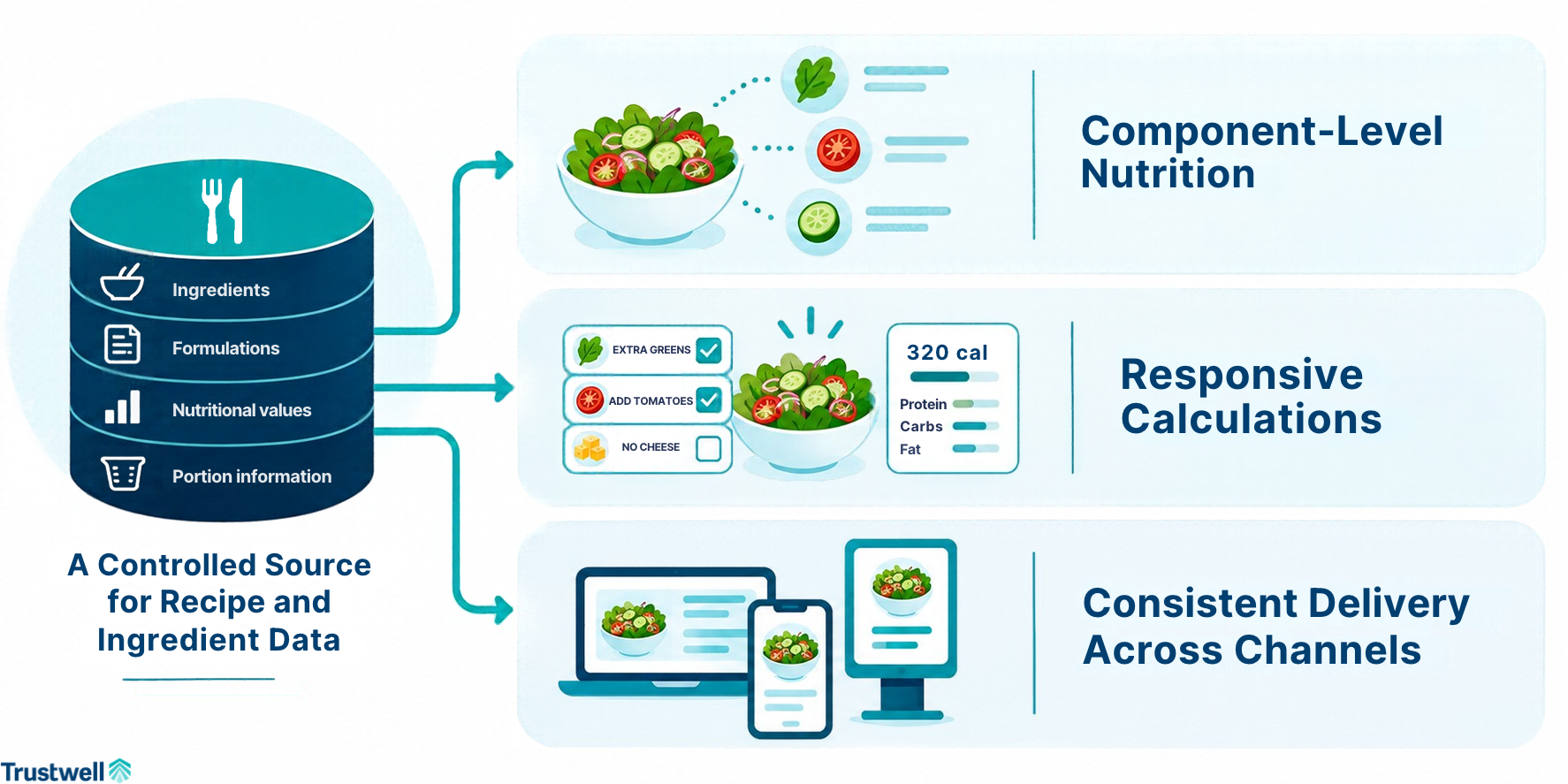
Restaurants can strengthen menu nutrition accuracy by connecting recipe management, modifier data, calculation logic, and digital ordering experiences through a consistent process.
Four capabilities are particularly important:
-
A controlled source for recipe and ingredient data: Restaurant teams need a consistent place to maintain ingredients, formulations, nutritional values, and portion information as menus evolve.
-
Component-level nutrition calculations: Customizable items require defined values for individual ingredients and modifiers so nutrition can reflect the combinations customers select.
-
Responsive calculation capabilities: When customers customize orders, the system needs a way to calculate the nutritional impact of those changes using the appropriate ingredient and portion data.
-
Consistent delivery across digital channels: Websites, applications, and kiosks should be able to access the same nutrition foundation rather than maintaining disconnected calculations.
With these capabilities working together, restaurant teams can make better use of their nutrition information while giving customers greater visibility into the nutritional composition of personalized meals.
Connecting Genesis Foods Nutrition Data to the Digital Menu
For restaurant brands already managing recipes and nutrition information in Genesis Foods, Genesis NutriLive provides a way to extend that data into customer-facing digital experiences.
The NutriLive API connects with Genesis Foods to retrieve nutrition information and calculate nutrient values for configurable menu items. As customers add, remove, or modify components, connected digital applications can display nutritional information reflecting those selections.
NutriLive returns label-rounded nutrient values, helping technical teams incorporate nutrition calculations into branded websites, mobile applications, kiosks, and interactive menu calculators. Because the API draws on the underlying Genesis Foods nutrition foundation, restaurants can build digital experiences around the recipe and ingredient information their teams already manage. Restaurant teams remain responsible for maintaining accurate source data, defining portions, and implementing calculations appropriately within their digital applications.
For restaurant brands balancing menu innovation with nutrition transparency, connecting Genesis Foods and NutriLive offers a practical way to deliver more responsive nutrition information throughout the digital ordering experience.
Menu Customization Shouldn't Compromise Nutrition Accuracy
Customers increasingly expect the flexibility to personalize their restaurant orders. Providing meaningful nutrition information alongside those choices requires restaurants to account for changes in ingredients, portions, and recipe formulations.
Restaurant teams can strengthen menu nutrition accuracy by maintaining consistent nutrition data, calculating modifications at the component level, and connecting those calculations to the digital experiences customers use.
When recipe information and digital calculations work together, customers can see nutrition values that better reflect the meals they create, whether ordering through a website, mobile application, or self-service kiosk.
Explore Genesis NutriLive to see how Trustwell can help bring dynamic nutrition calculations into your restaurant's digital menu experience with our downloadable cheat sheet.
Other posts you might be interested in
View All Posts
Product Formulation
4 min read
| July 26, 2021
How Carbs Are Calculated in Different Countries
Read More
Industry Regulations
12 min read
| February 27, 2023
Genesis Foods 11.13: Mexico and Canada Food Label Enhancements Released
Read More
Restaurants
11 min read
| August 27, 2026