

Food safety failures have always been expensive. What the recent Cyclospora outbreak demonstrated is just how quickly that expense can spread.
According to market data from Numerator, roughly $280 million in monthly produce spending is at risk as consumers react to the outbreak. More than 6.5 million U.S. households stopped purchasing salad mixes and kits over a recent four-week period.

NielsenIQ data provides another measure of the impact: Americans purchased approximately 7.6 million fewer pounds of lettuce during a four-week period this summer compared with the same period a year earlier.
Those are remarkable numbers.
But there is another reason corporate directors should pay attention to them. Most of that economic damage isn't happening inside the four walls of the organization where a food safety problem originated.
It is spreading across an ecosystem. Growers. Manufacturers. Restaurants. Retailers. Suppliers. Entire produce categories.
That should change the way boards think about food safety.
The Cost of an Outbreak is Larger Than a Recall
We tend to measure food safety events by what happens after a problem is identified. How much product was recalled? How much inventory was destroyed? How many facilities were affected? What will remediation cost?
Those are important questions. But they capture only the most visible portion of the economic impact. The Cyclospora outbreak offers a much broader picture.
Numerator found that more than a quarter of produce shoppers had stopped purchasing salads and fresh greens, while roughly one in ten had reduced spending in that part of the store.
The effects extended beyond grocery. Trips for salads at quick-service restaurants fell more than 16% during the period Numerator examined.
And the impact has not remained confined to lettuce. Consumers have reported reducing purchases of berries, herbs and other fresh fruits and vegetables as well.
A food safety event can therefore create something far more consequential than a product recall. It can create a confidence shock. And once consumers become uncertain about what is safe, the economic consequences can spread well beyond the products or companies ultimately determined to be responsible.
Uncertainty has a price for national retailers
During the recent outbreak, The Wall Street Journal reported that farmers markets were seeing consumers specifically seeking greater transparency around where their food came from. Some markets experienced substantial increases in traffic even as supermarket lettuce demand declined.
That is an important signal. Consumers don't need to understand the architecture of the food supply chain to recognize uncertainty. They respond to it.
Food safety is becoming a board-level issue
Corporate boards already oversee risks that have the potential to materially affect enterprise value. Cybersecurity. Financial controls. Supply-chain resilience. Regulatory compliance. Business continuity.
Food safety belongs in that conversation.
For a food company, a serious event can become an operational, financial, regulatory, legal, and reputational problem simultaneously. Yet boards can sometimes receive food safety information primarily through lagging indicators: Audit results. Incident counts. Recall statistics. Regulatory findings.
Those measures matter. But they largely tell directors what has already happened. Boards should also understand whether the organization has built the capabilities required to prevent an incident from becoming a crisis.
That requires a different set of questions.
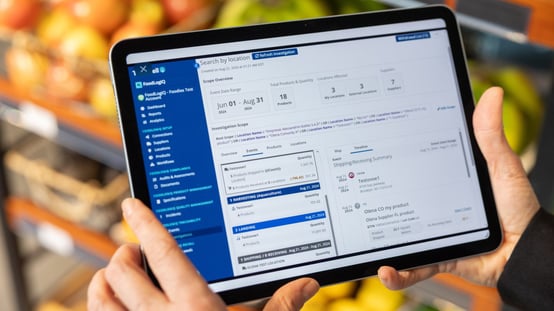
7 Questions Every Food-Company Board Should Ask
1. If a food safety issue emerged today, how quickly could we determine exactly what is affected?
Not approximately. Not after assembling a cross-functional team and reconciling spreadsheets. Exactly.
2. Can we trace ingredients and products in both directions?
Management should be able to understand where ingredients originated and where affected finished products ultimately went.
3. How connected is our information from recipe to recall?
Supplier data, ingredients, formulations, production, labeling and traceability are frequently managed by different teams and systems. During an incident, those boundaries disappear. The data needs to connect as quickly as the questions do.
4. Where are our biggest information blind spots?
Boards should understand which suppliers, facilities, product lines, or processes still depend heavily on manual records, emails, spreadsheets, or institutional knowledge.
5. How precisely can we isolate an affected population?
Traceability isn't simply about finding affected products. One of its greatest economic benefits may be confidently identifying what is not affected. Precision matters because uncertainty can turn a narrow incident into a much broader commercial problem.
6. When did we last test this under realistic conditions?
A traceability capability should not be judged solely by whether a process exists. Management should be able to demonstrate how the organization performs when speed, incomplete information, and cross-functional coordination are introduced.
7. What are we investing in before an incident occurs?
Perhaps this is the most important question. Because there is an enormous difference between having a recall plan and having an organization designed to minimize the likelihood and consequences of needing one.
From Response Plans to Resilience
The food industry has become extraordinarily capable at responding to crises. But response should not be confused with resilience. A company can execute an excellent recall and still experience enormous economic damage. The better question is what happened before the recall became necessary.
- Were supplier records connected?
- Could affected ingredients be immediately tied to formulations?
- Could formulations be tied to production lots?
- Could those lots be tied to customers and locations?
- Could leadership establish the scope of the problem without first assembling information from multiple disconnected systems?
These aren't simply technology questions. They're questions about operating capability. And they deserve board-level visibility.
The economics of prevention are difficult to see
During this outbreak, NielsenIQ data showed lettuce volume falling by roughly 7.6 million pounds over just four weeks compared with the previous year. Numerator estimates approximately $280 million of monthly produce spending is at risk while the crisis continues.
And those consequences extend to businesses that may have had nothing to do with the original contamination. That is what makes the economics of prevention different from many other investments.
The downside isn't necessarily contained to your company. And your company isn't necessarily insulated from someone else's failure.
Boards should ask before consumers do
The objective isn't to create a food system where incidents never occur. Agriculture and food production are too complex for anyone to credibly promise that. The objective is to build companies capable of identifying risks earlier, connecting information faster, narrowing uncertainty and acting with precision when something does happen.
Corporate directors don't need to become microbiologists or traceability experts to oversee that responsibility. But they should understand the organization's readiness.
They should ask management to demonstrate traceability rather than simply describe it. They should understand where critical food safety data resides and where gaps remain. They should know how quickly the organization can move from detection to decision.
And they should ask whether investments in prevention are being evaluated against the true potential cost of reaction.
Because the most important lesson from the Cyclospora outbreak may ultimately be economic as much as epidemiological. When confidence disappears, consumers don't wait for the investigation to conclude before changing their behavior.
Neither should boards wait for a crisis before asking whether their companies are prepared.
Tag(s):
Food Industry
,
Food Safety
,
Traceability
,
Trustwell Software
,
Food Recalls
,
Supplier Management
,
Food Safety Program
Other posts you might be interested in
View All Posts
Food Industry
4 min read
| October 17, 2025
reCONNECT 2025 | The Three Cs of Food Safety: What You're Missing
Read More
Food Industry
10 min read
| February 25, 2026
How Growing Food Companies Manage Supplier Compliance Without Slowing Operations
Read More
Product Formulation
5 min read
| October 9, 2025